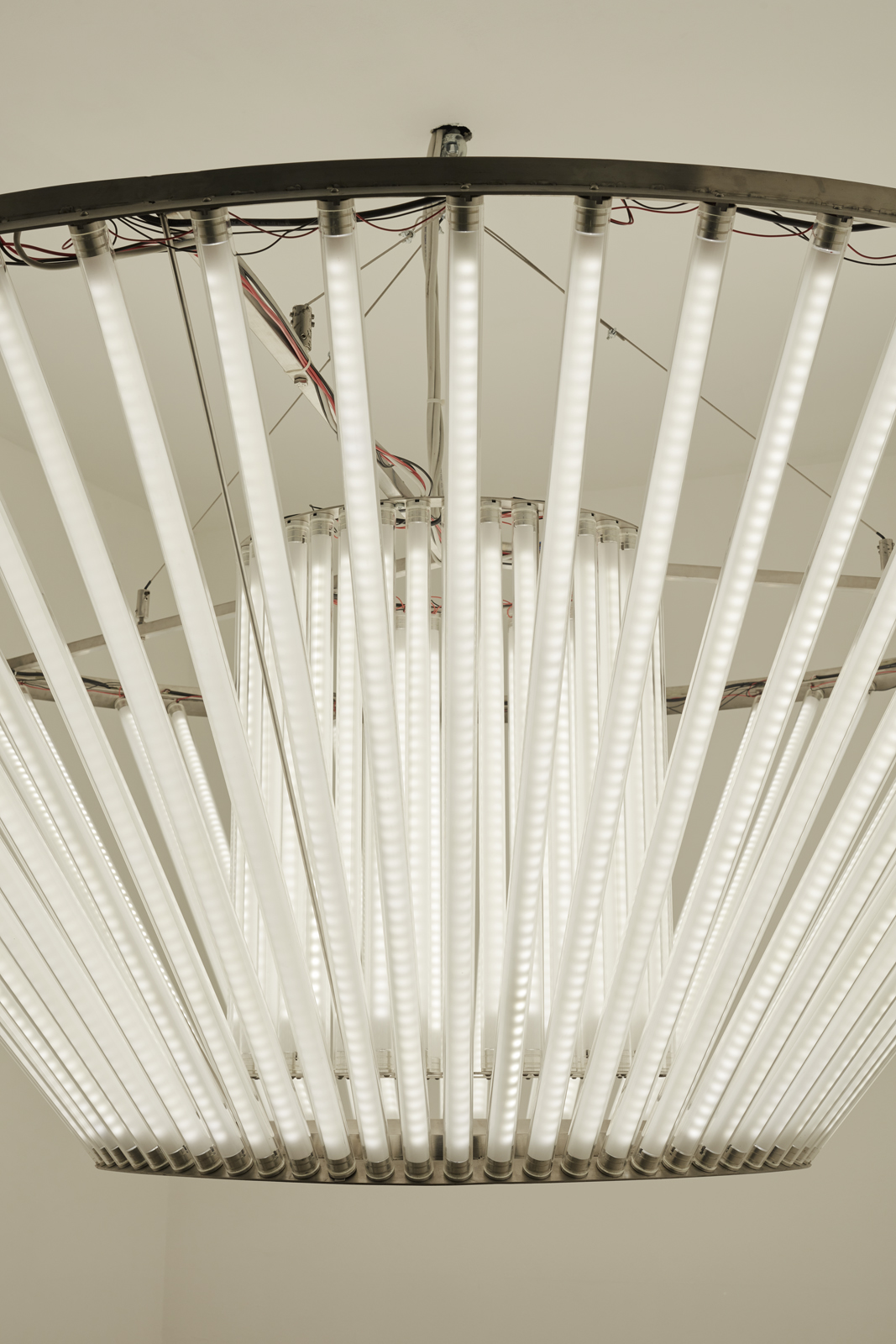
Since the late 1960s, the United States has witnessed a new conquest of the West. Pioneers of this new expansion to lands such as Texas, Colorado and Nevada, are artists coming from different paths, such as conceptual or minimal art, interested in questioning the definition of sculpture. In the expanded field of the desert, the rules decay, the boundaries between disciplines are thinning and the medium is no longer the center of interest, but is chosen in relation to the meanings that you want to develop. In 1977 Walter De Maria created The Lightning Field, a large lattice of 400 pointed stainless steel poles in a New Mexico plateau, which attract lightning discharges; the visitor looks at the work in a suspended wait, in a state of tension, because there is no certainty that the atmospheric phenomenon will occur during his stay in the area. However, the work is complete even without taking action, in a sort of pilgrimage in which the god may not reveal himself to his faithful. Storms by Alberto Garutti, on the other hand, bring lightning to the heart of our daily lives. If De Maria had manipulated the territory, Garutti manipulates the existing; like a virus sneaks into the electrical system and, every lightning that falls in Italy, changes the intensity of the chandelier, of the light, of the medium that at that moment is chosen as the work. The storm, on the other hand, takes place in an elsewhere that we do not know, that is not revealed to us; every lucky spectator thus imagines his thunder, his lightning, his sky. The work could appear without anyone watching it, it could never have an audience. Or, in the future, if the storms end, there may no longer be a world in which the work is activated. Perhaps the unsuspecting but devoted spectator, a bit Drogo a bit Estragon, would wait forever for a revelation. Garutti knows the laws of the world and gives us them as a gift: the work is in fact 'dedicated to those who pass by and think of the sky', not necessarily the one under which they are, perhaps another, far away from them. The other side is the center of many of the artist's works, aware that the truth we seek is always one step beyond our center of gravity.
