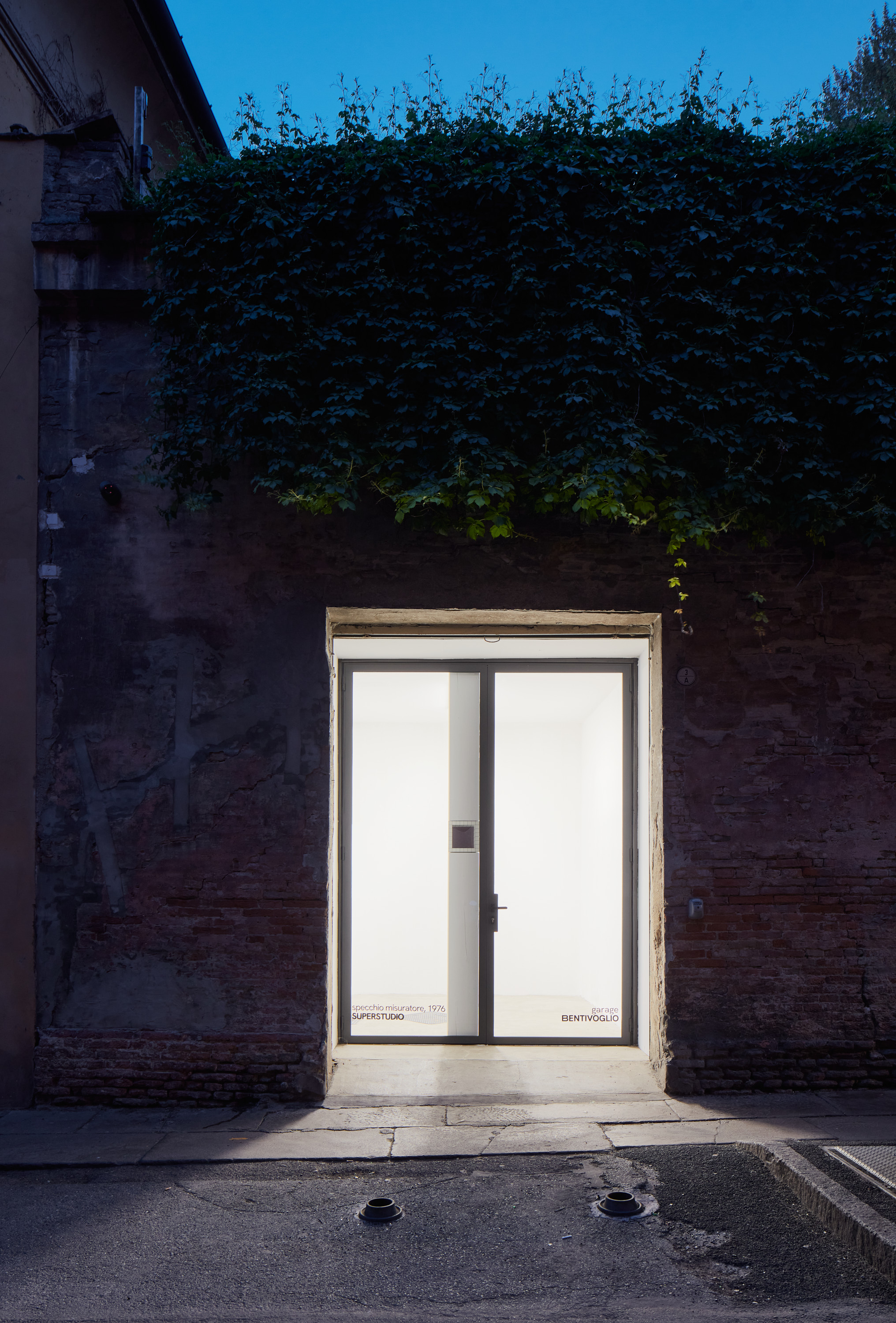
Barely large to contain our eyes, yet it condenses some of the fundamental themes of the thought of its creators, such as measure and reflection. The measuring mirror is part of the research on the reflected image that accompanies Superstudio throughout its existence, starting with the Niagara Falls project in 1970 or the cover of Casabella in 1972, clearly inspired by Magrittian. Since the beginning, mirrors have in fact acquired a fundamental meaning for the Florentine avant-garde, rising to the scale of the landscape with pure forms devoid of practical functions, in the wake of the great works of Land Art from which they are inspired. Among others, Robert Smitshon's research is a point of reference, especially in the use of mirrors as a device for investigating the world, capable of doubling it but also of highlighting its contradictions. The measuring mirror is then wrapped in the characteristic squared laminate, the last stage of decoration and heir to the Cartesian grid, which from Mercator onwards became the only measuring instrument in the world. Like all Superstudio objects, it is totally self-representative, it was not created to satisfy primary needs, for which tools exist, but it is an industrial artifact full of sacred and mythical values; in the new domestic landscape, the technique in fact meets every elementary need, there is no longer an opportunity for consumption and man surrounds himself only with tools and symbolic objects. The architect no longer has opportunities to design, because the only project “is the project of our life and of our relationships with others.” At the bottom of this small mirror, however, only our gaze re-emerges; the world and its contradictions are contained in our eyes: Superstudio questions ourselves, our fears and monstrosities. “Instead, we prefer to be shepherds of monsters; summoning them from within our magic circle, we look after them and feed them so that they grow up and go wild around them.” The Uffizi Gorgone is more alive than ever.